In the modern world, our nervous system is constantly humming, often stuck in an unnecessarily high-alert state. We are wired for survival, but that ancient wiring is now constantly tripped by emails, traffic, and endless to-do lists. The good news? You hold the power to change this. At MindLines™, we prove that art and creative practice are some of the fastest, most profound ways to manually shift your internal state.
The Two Modes of Your Inner Wiring
Your autonomic nervous system (ANS) runs the show without you having to think about it, but it operates in two essential modes:
- The Sympathetic Nervous System (The Accelerator): This is your stress and action mode—your “fight or flight” response. It’s triggered by real danger, but also by perceived stress. When this is active, your body pumps out cortisol, increases your heart rate, and focuses all energy on survival, leaving you feeling anxious and rigid.
- The Parasympathetic Nervous System (The Brake): This is your rest and digest mode. This is the state where healing, deep clarity, and complex thought occur. To regulate your state, the goal is always to intentionally activate this “brake.”
🧠 The Stress Trigger: Thoughts as Biological Events
The most insidious part of modern stress is that you don’t need a physical threat to activate the accelerator; your thoughts alone are enough. As neuroscientist and author Dr. Joe Dispenza powerfully teaches, the stress response can be triggered by thought alone.
When you mentally rehearse past failures, worry about the future, or judge your current circumstances, your body releases the same powerful stress chemicals (like cortisol and adrenaline) as if you were facing immediate danger. You are literally turning a persistent thought pattern into a biological emergency. Over time, these stressful thoughts become an unconscious, habitual emotional state, keeping your nervous system chronically activated and stuck in fight-or-flight mode.
Neuroaesthetics: Art as an Antidote to Anxiety
This is where art and intentional creativity step in as a neurological circuit breaker.
Neuroaesthetics, a field pioneered by figures like neurobiologist Semir Zeki, studies what happens in the brain when we create or experience beauty. Zeki’s research suggests that engaging with art activates the brain’s pleasure and reward centers, specifically those rich in dopamine receptors. This reward response does two critical things:
- It signals a feeling of safety and pleasure, which directly counters the stress signal generated by negative thought loops.
- It promotes the release of neurochemicals that naturally push the ANS toward the parasympathetic ‘rest’ state.
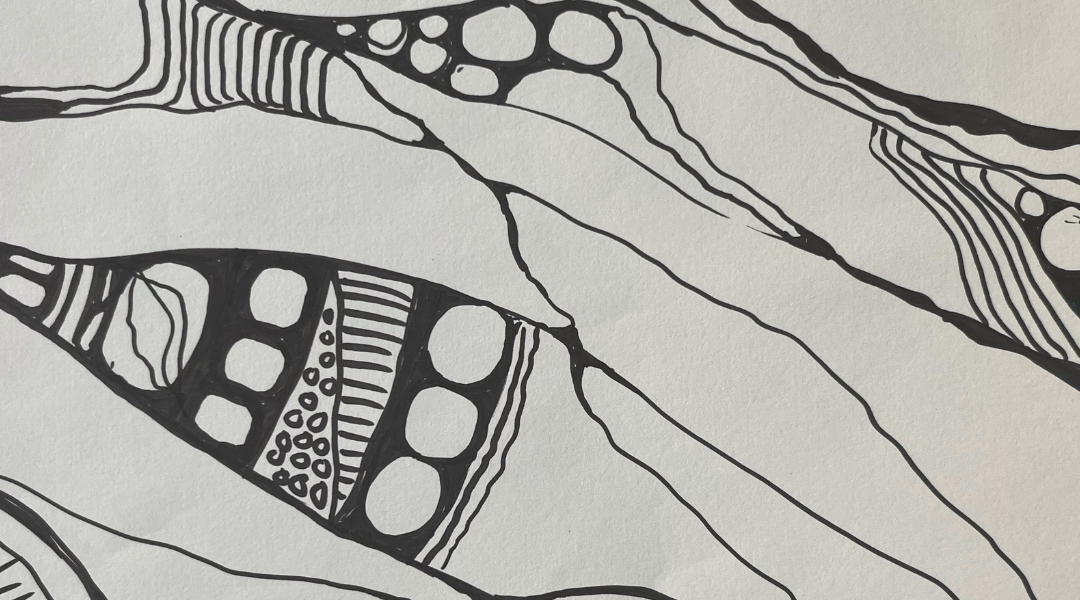
When you are deeply focused on mixing a color, drawing a line in Neurographica, or even concentrating on the effort of non-dominant hand drawing, you engage in an activity that is absorbing, non-threatening, and rewarding. You move beyond your analytical, worrying mind and enter a state of flow, which is the nervous system’s preferred state of balance.
Actively Rewiring for Calm
The MindLines™ methods are not about making pretty pictures; they are about using creative action to deliberately regulate your nervous system.
Methods like Neurographica force you to move slowly, mindfully, and intentionally. This action—the steady breathing, the focused movement—sends a powerful, undeniable signal of safety to your brain, interrupting the habitual stress loop caused by thought alone.
By consistently choosing creative action, you are actively leveraging neuroplasticity to build stronger pathways for calm and clarity. You are giving your nervous system the practice it needs to hit the brake, transforming chronic reactivity into resilient peace