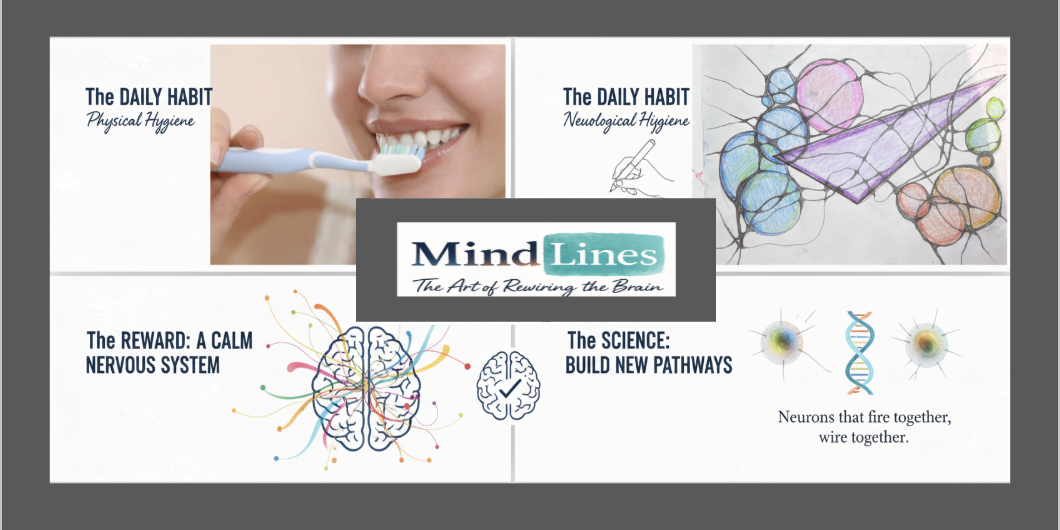
We’ve all been there. You wake up, the to-do list starts screaming in your head, and the internal negotiator begins: “I’ll draw tonight,” or “I’m too busy to get the pens out today.” Now, imagine if you had that same internal debate about brushing your teeth. You wouldn’t. You don’t negotiate with your toothbrush; you don’t weigh the “ROI” of dental hygiene against your morning emails. You just do it. It is a non-negotiable habit that preserves your health.
In the MindLines philosophy, we treat daily drawing exactly the same way. It isn’t just “art”—it is neurological hygiene.
After completing our 5-week course, you have five distinct methods at your fingertips. But having the tools is only half the battle. The true magic happens when these tools move from your “toolbox” into your “autonomic nervous system.” Today, we’re diving into the science of why a daily habit is the only bridge between where you are and the goal you want to achieve.
1. The Architecture of Change: James Clear and Atomic Habits
If you want to achieve a goal—whether it’s recovering from a health setback like Parkinson’s or simply lowering your baseline stress—you must stop focusing on the goal and start focusing on the system.
As James Clear, author of Atomic Habits, famously says: “You do not rise to the level of your goals. You fall to the level of your systems.”
Drawing every day is the system. When you draw for just 15 to 30 minutes daily, you are casting a “vote” for the person you want to become: someone who is calm, resourceful, and in control of their biology. Habit formation is the process by which a behavior becomes increasingly automatic through repetition. By removing the “negotiation phase,” you save your precious executive function for high-level tasks, rather than wasting it on deciding whether or not to take care of your brain.
2. “Neurons That Fire Together, Wire Together”: The Hebbian Principle
Why does repetition matter so much? We look to Dr. Donald Hebb, the father of neuropsychology. Hebb’s Law states that “neurons that fire together, wire together.”
When you first learn a MindLines method, the neural pathway is like a faint trail in a thick forest. It’s hard to walk; it requires effort. However, every time you pick up that pen and engage the “neural bypass,” you are firing those neurons again.
Daily repetition acts like a steamroller, widening that faint trail into a paved highway. Eventually, your brain learns to access “resourceful states” (calm, focus, creativity) with almost no effort. If you only draw once a week, the “forest” grows back over the path. Consistency is the only way to keep the highway open.
3. The Plastic Brain: Merzenich, Doidge, and the Power of Remapping
For decades, we believed the brain was “fixed” after childhood. Dr. Michael Merzenich, a pioneer in neuroplasticity, and Dr. Norman Doidge, author of The Brain That Changes Itself, proved otherwise.
They showed that the brain is “plastic”—it is constantly remapping itself based on input. Merzenich’s research highlights that focused attention is the key to plasticity. When you draw a neurographic line, you aren’t just doodling; you are engaging in a high-focus, tactile task.
This daily input tells your brain: “This new state of calm is important. Allocate more real estate to it.” By drawing every day, you are literally physically re-engineering your brain’s maps, moving away from “stuck” patterns of illness or stress toward new patterns of fluidity and health.
4. Safety First: Dr. Stephen Porges and Polyvagal Theory
We cannot be resourceful if our body thinks we are under attack. Dr. Stephen Porges, creator of Polyvagal Theory, teaches us about the “Window of Tolerance.” When we are stressed, our nervous system shifts into “Fight or Flight” or “Shutdown.”
Daily drawing acts as a “Vagal Brake.” Through the rhythmic, repetitive motion of the pen, you signal to the ventral vagal complex that you are safe.
By making this a daily habit, you lower your “resting heart rate” of stress. You train your nervous system to return to a state of safety more quickly after a disruption. This is why our students often find that after a few weeks of daily practice, things that used to trigger them simply don’t have the same power anymore. You’ve habituated safety.
5. Mindsight and Integration: Dr. Daniel Siegel
Dr. Daniel Siegel coined the term “Mindsight”—the ability to see the internal workings of our own minds. He speaks of “Integration” as the heart of health.
Integration is when different parts of the brain (the logical left and the creative right; the emotional limbic and the thinking cortex) work together in harmony. Daily drawing is a tool for bilateral integration. You are using your hands (motor cortex) to express emotions (limbic system) while following a method (prefrontal cortex).
Doing this daily creates a “coherent” brain. According to Siegel, a coherent brain is a resilient brain. A daily MindLines habit ensures that your “internal orchestra” is tuned and ready to play, rather than clashing in discord.
6. The Power of “Leaking” Stress: Pennebaker and Expressive Writing
While MindLines is visual, it shares a scientific foundation with the work of Dr. James Pennebaker. Pennebaker’s research on “Expressive Writing” showed that translating emotional upheaval into a physical form (writing it down) improves immune function and reduces doctor visits.
Drawing functions as “Expressive Drawing.” It allows the “unspoken” stress to leave the body and land on the paper. By doing this daily, you prevent the “accumulation” of emotional toxins. You are essentially “emptying the trash” of your subconscious every 24 hours.
7. Why Five Methods? The Power of Choice
In our 5-week course, we don’t just teach one way to draw. We teach five. Why? Because as your environment changes, your needs change.
- On a day when you are angry, you might need the Catharsis method.
- On a day when you feel stuck, you might need the Goal-Manifesting method.
- On a day when your Parkinson’s tremors are high, you need the Neural Bypass method.
By having five habits to choose from, you ensure that the habit never becomes boring, and it always remains “fit for purpose.”
Conclusion: The Non-Negotiable Life
Achieving a goal—whether it is health, peace, or professional success—requires a nervous system that can handle the journey. You cannot build a skyscraper on a swamp; you cannot build a successful life on a dysregulated nervous system.
Daily drawing is the “bedrock” work. It is the dental hygiene of the soul.
When you sit down today, don’t think about making “art.” Think about Dr. Hebb and those neurons firing. Think about Dr. Porges and your vagus nerve. Think about James Clear and the system you are building.
Stop negotiating. Pick up the pen. Your brain will thank you for it tomorrow.
Reflection for the Week:
If you haven’t drawn today, what is the “negotiation” your mind is using? How would your day change if you treated your 15-minute drawing session with the same “must-do” attitude as your morning coffee or brushing your teeth?